
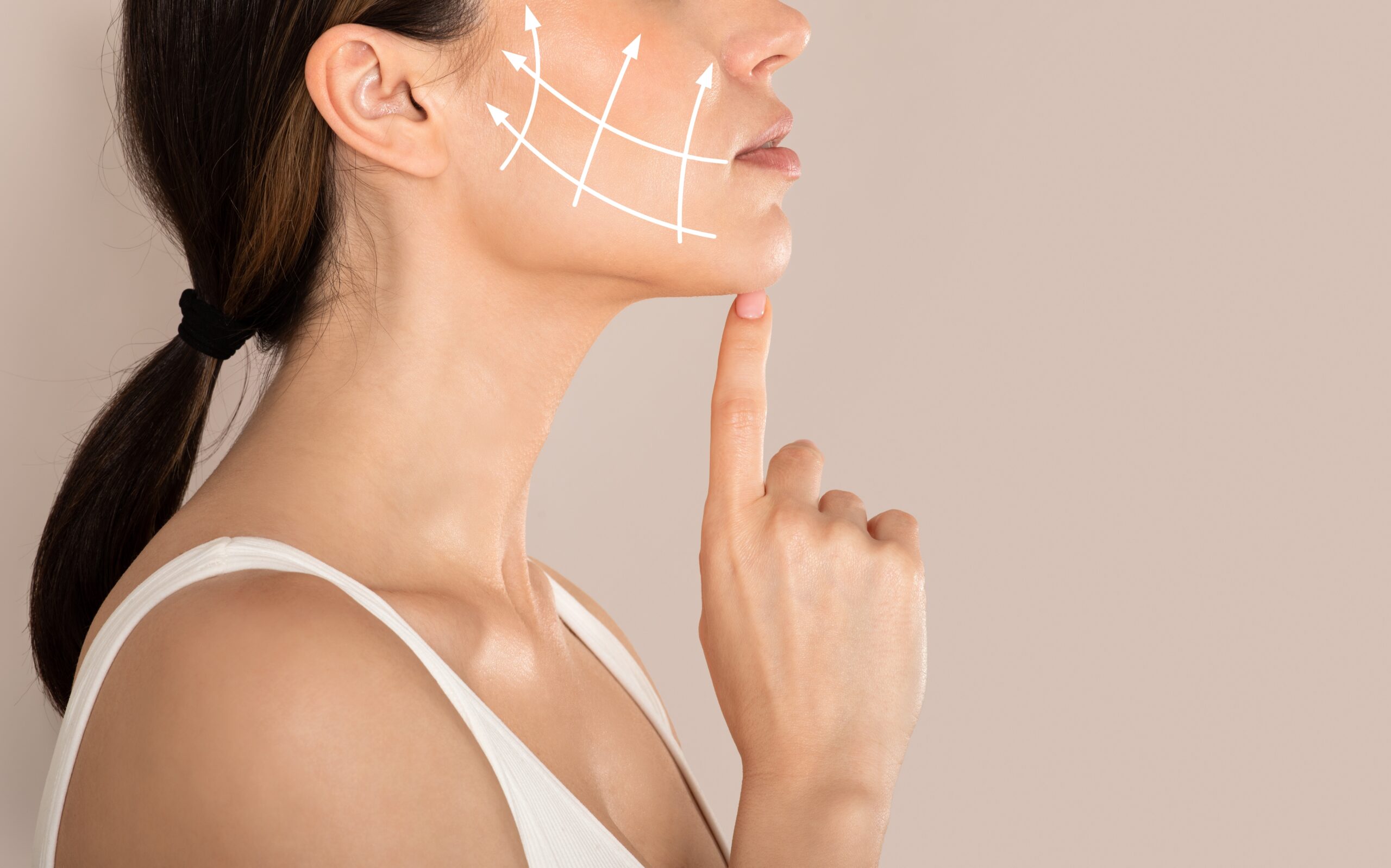
Skin Laxity — Non-Surgical Lifting Options, Central Hong Kong
Skin laxity is not the same as wrinkles. Wrinkles are lines on the surface. Laxity is the deeper loss — the feeling that the skin is no longer holding its position the way it used to. This page is about skin laxity — what causes it and the non-invasive treatment options that can help restore firmness and definition.
Skin laxity refers to the loss of firmness and elasticity in the skin, often resulting in sagging or drooping. It is caused by several factors including declining thickness and structural support beneath the skin. As the foundational layers weaken, the skin loses its ability to bounce back, leading to a tired or heavy appearance — particularly along the jawline, cheeks, brow, and neck.
What Causes Skin Laxity
Collagen Depletion: Collagen decreases by about one per cent per year after age twenty, leading to thinner, looser skin. Collagen is the structural scaffolding that holds the skin’s shape. As production slows, the scaffold weakens and the skin begins to sag.
Elastin Degradation: Elastin fibres, which allow skin to snap back after stretching, break down over time, reducing elasticity. Once damaged, these fibres do not regenerate easily, and the skin becomes less able to return to its original position after movement or gravitational pull.
Reduced Hyaluronic Acid and Moisture: The skin produces less hyaluronic acid and fewer natural oils with age, leading to dryness and sagging. Hyaluronic acid is a key molecule that holds water in the skin, contributing to its plumpness and resilience. As levels drop, the skin deflates and laxity becomes more visible.
Fat and Bone Loss: With age, facial fat pads shrink and bones lose density, reducing structural support from beneath. This creates the hollowing and descent of features that make laxity appear more pronounced. The mid-face, temples, and under-eye area are particularly affected.
Slower Cell Turnover: Skin cells regenerate more slowly with age, leading to dull, thin skin. This not only affects appearance but also undermines the skin’s structural integrity over time.
Hormonal Changes: Declining oestrogen levels, particularly during menopause, reduce collagen production and skin hydration. This hormonal shift can accelerate the visible onset of laxity in many individuals.
Treatment Approaches at The Skin Oracle
Ultherapy Prime— For Non-Invasive Collagen Stimulation: Ultherapy Prime uses focused ultrasound energy to heat the deep foundational layers of the skin — the same layers that are targeted in a surgical lift, but without any cutting. This stimulates the production of new collagen, gradually lifting and tightening the skin over two to three months. It is particularly effective for the brow, jawline, and neck. Results can last up to a year or more, and a single session is often sufficient. Learn more about Ultherapy →
Elite IQ — For Laser-Based Lifting with Multi-Concern Versatility: Elite IQ, manufactured by Cynosure Lutronic, is a dual-wavelength 755nm and 1064nm laser platform that delivers controlled bulk heating to the dermis. This thermal effect triggers immediate contraction of existing collagen fibres and stimulates progressive tightening over the following months. Elite IQ is particularly suited for individuals with mild to moderate laxity who also have pigmentation, vascular, or texture concerns that could benefit from simultaneous treatment. Sessions typically take 30 to 60 minutes with no downtime. Learn more about Elite IQ →
Aptos Thread Lift — For Immediate and Lasting Lift: Aptos uses dissolvable threads with small barbs or cones that are placed beneath the skin to physically lift and reposition sagging tissue. The threads also stimulate collagen production around them, providing a dual action — immediate lift plus ongoing improvement over several months. Aptos is well-suited for the mid-face, jawline, and brows, offering results that feel natural and last up to 18 months depending on the type of thread used. Learn more about Aptos →
Combined Approaches: For some individuals, the best results come from combining Ultherapy Prime’s deep collagen stimulation with Aptos’ mechanical lift. This layered approach addresses both the foundational weakening and the gravitational descent that together create the appearance of sagging.
Selecting the Appropriate Treatment
The choice depends on the degree of laxity and individual goals. For mild to moderate laxity with good skin quality, Ultherapy Prime alone can provide a noticeable lift without any downtime. For more pronounced sagging — particularly in the mid-face or jawline — Aptos Thread Lift offers a more immediate, visible result.
If laxity is combined with significant volume loss, the treatment team may recommend pairing a treatment like Profhilo or a dermal filler with Ultherapy Prime or Aptos for comprehensive rejuvenation.
Most individuals begin to notice some degree of laxity in their mid-thirties to forties. However, genetics, lifestyle, and sun exposure can accelerate or delay the process. Ultherapy Prime has no downtime — normal activities can resume immediately, though some temporary tenderness or tingling is normal. Aptos Thread Lift may involve some mild swelling, bruising, or tightness for a few days, but most clients return to their routine within 24 to 48 hours.
Ultherapy Prime results typically last 12 to 18 months as the stimulated collagen gradually rebuilds. Aptos results vary by thread type but generally last 12 to 18 months. Maintenance sessions can extend the results. Many clients combine Ultherapy Prime or Aptos with treatments like Profhilo for hydration or fillers for volume restoration.
Related Treatments
For complementary approaches, see Ultherapy Prime and Aptos Thread Lift. All available under skin concerns.